What Institutional Investors Have Known for Decades
And why advisers are increasingly adopting the same approach to private equity
By Ben Dixon, Continental Funds Group
Many of today's fastest-growing businesses remain private for longer, meaning a growing share of company value creation occurs outside public markets. As a result, private equity is becoming an increasingly important consideration in portfolio construction.
When we speak to financial advisers today, there are a few themes that come up time and again.
Markets are becoming increasingly interconnected. Listed equities can be volatile. Fixed income continues to play an important role, but it may not always provide the diversification benefits it once did. And clients are asking more questions about where future returns are likely to come from.
At the same time, advisers are under pressure to build portfolios that can withstand different market environments while still delivering long-term growth.
It's not an easy balancing act.
Over the past decade, one area that has increasingly attracted attention is private markets, particularly private equity. Once considered the domain of large superannuation funds, and sovereign wealth funds, private equity is steadily becoming a more mainstream consideration within wealth management portfolios.
The reason is relatively straightforward.
Many of the world's most successful businesses are staying private for longer. In many cases, a significant portion of a company's growth journey now occurs before it ever reaches public markets. If advisers are only looking at listed equities, they may be overlooking an increasingly important part of the investment universe.
That doesn't mean private equity should replace public markets. Far from it.
Rather, many advisers are beginning to view private equity as a complementary allocation that can potentially broaden diversification, provide exposure to different return drivers and access opportunities that simply aren't available through listed markets.
Looking beyond the traditional portfolio
For years, the traditional balanced portfolio of equities and bonds served investors well and formed the backbone of portfolio construction. While those foundations remain important, the investment landscape has evolved significantly.
Today, some of the world's most innovative companies remain private for far longer than previous generations of businesses. Private capital has become a major source of funding, enabling companies to expand without relying on public markets.
As a result, advisers are increasingly asking whether traditional portfolios provide sufficient exposure to the full opportunity set available to investors.
Private equity helps address that challenge.
It expands the investable universe beyond listed markets and may reduce reliance on public market movements as the sole driver of portfolio outcomes.
U.S. companies are going public later, with almost 90% of U.S. companies with greater than $100 million revenue private today
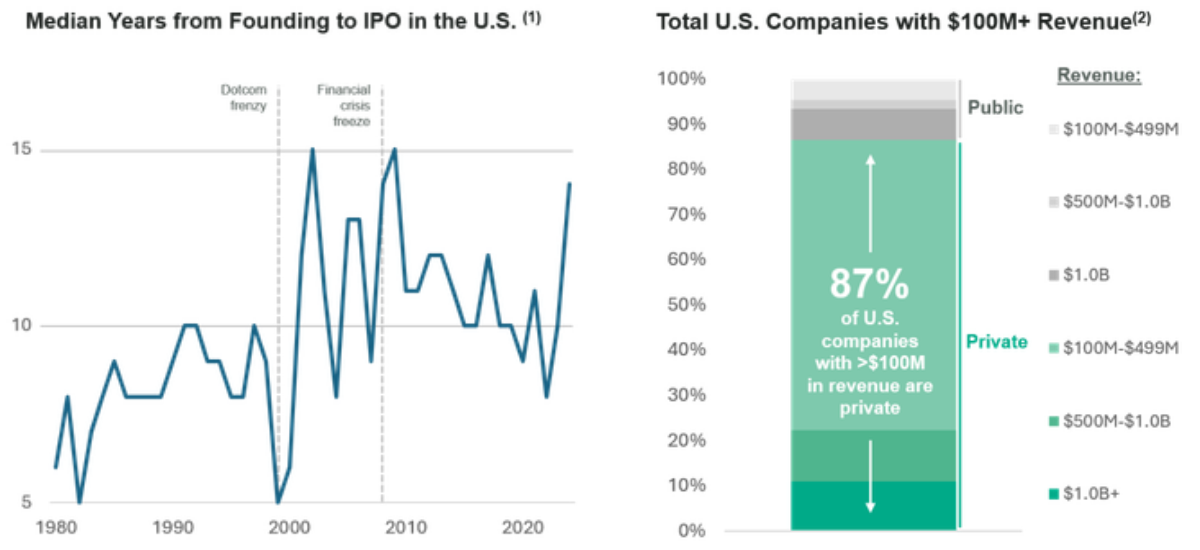
Source: (1) Financial Times; Jay R. Ritter, University of Florida; Calendar year of IPO minus calendar year of founding; (2) S&P Capital IQ. For companies with last 12-month revenue greater than $100M by count.
Understanding the role of private equity
One of the most common misconceptions we encounter is that private equity is a standalone investment idea. In reality, private equity often works best when considered as part of a broader portfolio construction framework.
For many investors, its role is not to replace equities or fixed income, but to sit alongside them.
Private equity can provide:
- Exposure to a broader investment universe beyond listed markets
- Access to businesses before they become publicly traded
- Active ownership and operational value creation
- Diversification benefits through lower correlation to daily market movements
- Potential for attractive long-term returns driven by business growth
Importantly, private equity managers do far more than allocate capital. They typically work alongside management teams to help businesses grow, improve operations, pursue strategic acquisitions and expand into new markets, an approach known as active ownership. For investors, this can provide an additional source of value creation beyond simply participating in market movements.
Private equity isn't one asset class, it's a spectrum of strategies.
Another mistake we frequently see is treating private equity as a single asset class.
The reality is much more nuanced. Just as advisers diversify listed equity allocations across sectors, styles and geographies, private equity portfolios can likewise be diversified across different investment approaches.
At a high level, there are several distinct segments.
Growth Equity
Growth managers typically invest in established companies looking to accelerate expansion. These businesses may be entering new markets, developing new products or scaling existing operations. Returns are often driven primarily by business growth rather than financial leverage.
For advisers seeking exposure to innovation and long-term structural growth themes, growth equity can be an attractive component of a private markets allocation.
Buyout Strategies
Buyout managers acquire controlling stakes in businesses and work to create value over time. Within buyouts, there are meaningful differences between large-cap and middle-market investing.
Large-cap buyout managers often focus on established businesses with significant scale and market share. Middle-market managers, meanwhile, tend to target smaller businesses where operational improvements and strategic initiatives can have a greater impact on future value creation.
Many buyout transactions utilise a combination of equity and debt financing, commonly referred to as a leveraged buyout (LBO). This is where private credit often plays a role, providing financing that supports the acquisition and growth of the business. As a result, private equity and private credit are often closely connected within the private markets ecosystem, with investors gaining exposure to different parts of a company's growth journey and capital structure.
Many institutional investors allocate across both middle-market and large-cap buyout strategies, recognising that each can provide exposure to different opportunity sets, risk profiles and drivers of return.
Venture Capital
Venture capital sits at the higher-risk end of the spectrum, investing in earlier-stage businesses. While venture portfolios can produce exceptional outcomes, they generally carry greater uncertainty and wider dispersion of returns.
For many investors, venture capital represents a smaller allocation within a broader private markets portfolio.
Building a well-rounded private equity allocation
One lesson institutional investors have demonstrated over many decades is that diversification matters just as much in private markets as it does in public markets.
Rather than relying on a single manager or strategy, many investors build exposure across multiple dimensions:
- Growth and buyout strategies
- Large-cap and middle-market managers
- Different sectors and geographies
- Multiple investment vintages
- Varying manager styles and philosophies
In practice, this might involve combining a global growth manager, a middle-market specialist and a larger buyout platform. Each strategy may behave differently depending on market conditions, creating a more balanced private equity exposure over time.
We believe the objective is not to identify a single "best" manager. It's to construct a portfolio capable of capturing opportunities across different parts of the private equity market.
Turning private equity access into portfolio outcomes
Private equity isn't suitable for every investor.
It requires patience, a long-term mindset and an understanding that capital may be committed for several years. Liquidity is typically lower than traditional listed investments, and outcomes are often realised over full market cycles rather than quarterly reporting periods.
However, for investors with a medium- to long-term investment horizon, private equity can provide access to opportunities that are increasingly difficult to find in public markets alone.
The important question is how to build diversified exposure across manager styles, company sizes, sectors and stages of growth while balancing liquidity requirements and client objectives.
For advisers beginning their private markets journey, the starting point is often not selecting a manager, but determining the role private equity should play within the broader portfolio. Much like listed equities, private equity encompasses a diverse range of investment styles, risk profiles and return drivers.
Many institutional investors begin with an allocation to diversified buyout or growth equity strategies, before expanding exposure across different segments of the market. Over time, allocations may include a combination of large-cap and middle-market managers, growth equity, buyout strategies and even secondaries. Each can provide exposure to different stages of a company's lifecycle and different sources of risk and return.
A practical approach for advisers may be to view private equity as part of a growth alternatives allocation within a client's portfolio. Rather than relying on a single manager or strategy, investors can gradually build exposure across multiple managers, vintages, sectors and geographies, creating a more balanced private markets portfolio over time. However, diversification alone is not enough. Manager selection is arguably even more important in private markets than in listed equities, as return dispersion between top and bottom quartile managers has historically been significant1. The ability to source attractive investments, support portfolio companies and execute value creation strategies can have a meaningful impact on long-term returns. As a result, manager quality remains one of the most important drivers of success in private equity investing.
For advisers, that portfolio construction challenge may ultimately prove just as important as the decision to allocate to private equity in the first place. The opportunity is no longer just gaining access to private markets — it is building a portfolio that captures the breadth of opportunities available across them.
1. Source: Cambridge Associates, U.S. Private Equity Index and Selected Benchmark Statistics.
This information contains general financial product advice only and has been prepared without taking into account the objectives, financial situation or needs of any particular person. It is intended solely for wholesale clients (including sophisticated investors) as defined under sections 761G and 761GA of the Corporations Act 2001 (Cth). This information is supplied on the following conditions which are expressly accepted and agreed to by each interested party (‘Recipient’).
The information provided should not be considered personal advice, a recommendation, or an offer to invest. Recipients should not rely on this information in making investment decisions. A Recipient should, before making any investment decisions, consider the appropriateness of the information, any relevant offer document, and seek independent financial advice.
Past performance is not a reliable indicator of future performance. Continental Funds Group Pty Ltd ACN 688 643 245 AR No.001317974 (CFG), does not make any representation or warranty, express or implied, as to accuracy, reliability or completeness of this information or subsequently provided to the Recipient or its advisers by CFG, including, without limitation, any historical financial information, the estimates and projections and any other financial information derived there from, and nothing contained in this information is, or shall be relied upon, as a promise or representation, whether as to the past or the future. All investments contain risk.